
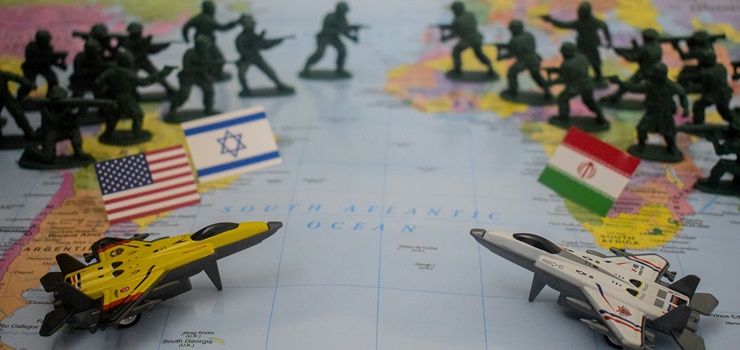
As tensions continue to rise in the Middle East, many people across Australia are feeling the weight of constant news updates and global uncertainty. While the conflict is happening thousands of kilometres away, the immediacy of modern media can make it feel close to home.
Media Commentator, Pastor and Journalist Steve McAlpine caught up with Leah and Dan on Brekky, offering practical guidance on how Christians can respond thoughtfully and faithfully during times of global unrest.
He shared some valuable insights on navigating anxiety, supporting others, and finding hope when the world feels unsettled.
Why Global Conflict Feels So Overwhelming Today
One of the biggest differences between modern conflicts and those in the past is how quickly information spreads. McAlpine explains that the speed of news updates can amplify feelings of stress and helplessness.
“Everything updates not just daily, but hourly,” he said. “The closer you get to technology that lets you see everything quickly, the more overwhelmed you can become.”
He contrasted today’s constant stream of information with earlier times in history.
“During the Second World War, people would go to the movies and watch a news reel showing something that happened a month earlier,” he said. “Now we get updates by the hour, and sometimes we don’t even know if half of them are true.”
As a result, global events can feel far more immediate and emotionally draining, even for those living far from the conflict.
Common Emotional Pitfalls to Watch For
When news cycles are intense, it’s easy to fall into unhealthy emotional patterns. McAlpine highlighted two common responses: despair and anger.
First, there is the temptation to believe the world has never been this chaotic. “We can slip into despair and think the world has never been like this before,” he said. “Clearly it has, we’re just seeing it right up front.”
Another common reaction is anger. In a world where everyone has a platform, opinions can quickly become divisive. “Everyone has an opinion all the time, including me,” McAlpine said. “We’ve become opinion writers ourselves, even in our own heads.”
This can lead to increased tension between people, particularly when discussions about global conflicts arise in everyday spaces like workplaces, schools, or social media.
Practical Ways Christians Can Respond
While global conflict can feel overwhelming, McAlpine believes local compassion and care remain powerful responses. Christian communities, he says, have a unique opportunity to support those personally affected by international crises.
“There are many people in Australia who are affected because they have family in those regions,” he said. “It hits close to home for them.”
Simple acts of kindness and support can make a meaningful difference. “You might have neighbours or people at the school gate who come from those areas,” McAlpine said. “How can we show we care about the people around us?”
For Christians, this compassion extends to everyone, not just those who share the same background or beliefs. “We want to go to the person who’s not like us as well as the person who is like us,” he said.

Why Prayer Is a Powerful Response
In moments of global tension, prayer can sometimes feel like a small response. However, McAlpine encourages believers to see it differently. “If we believe in God, then prayer is practical,” he said.
He encourages Christians to regularly pray for political leaders, not just during crises, but as an ongoing practice. “We should already be leaning into praying for our leaders privately and in church,” he said.
Specifically, McAlpine suggests praying for wisdom and stability as leaders navigate complex global challenges. “Pray for wisdom and a steady hand,” he said. “And don’t become partisan in how you pray. Pray for your prime minister, pray for the opposition leader – because the Bible tells us to do that.”
He added that prayer should come with genuine belief that God can guide leaders. “If you’re going to pray it, believe that God can do that.”
Holding on to Hope in Troubled Times
Despite uncertainty and conflict, McAlpine says Christians can hold onto a deeper hope that transcends world events. “For me, hope comes from knowing there is a king above every president, prime minister, or ruler,” he said.
That hope, he says, is ultimately found in Jesus. “One day His rule will look like true justice, truth, righteousness and hope,” McAlpine said. “That gives us joy even in the midst of trouble.”
While Christians are still called to engage with the issues of the world, this perspective can bring peace and stability in uncertain times.
You can re-visit Leah and Dan’s full chat with Steve McAlpine below.