
We always love chatting with Matt Woods from the Perth Observatory, and this week’s Science Segment on Drive with Bec was full of fascinating discoveries – from an interstellar visitor flying through our solar system to a record-breaking black hole merger that’s challenging everything we thought we knew.
Here’s a recap of the cosmic highlights:
A Cosmic Drive-By: Interstellar Comet 3I/ATLAS
Astronomers have recently discovered a new interstellar comet named 3I/ATLAS—the third of its kind ever observed. “Interstellar” means it didn’t originate in our solar system. It’s just passing through, taking a quick galactic sightseeing trip before heading back out into deep space.
“It’s like a visitor doing a fly-by, taking a few photos, and posting them to interstellar Facebook,” Matt joked.
This comet is particularly intriguing because it’s chemically different from previous interstellar objects. Spectroscopy shows it has a deep red colour, suggesting it’s rich in organic molecules and has been exposed to cosmic rays for billions of years.
And it’s fast – really fast. It’s travelling at 57 kilometres per second, which means it could travel from the Perth CBD to the Observatory (about 36 km) in just over half a second.
Black Hole Merger Breaks Records
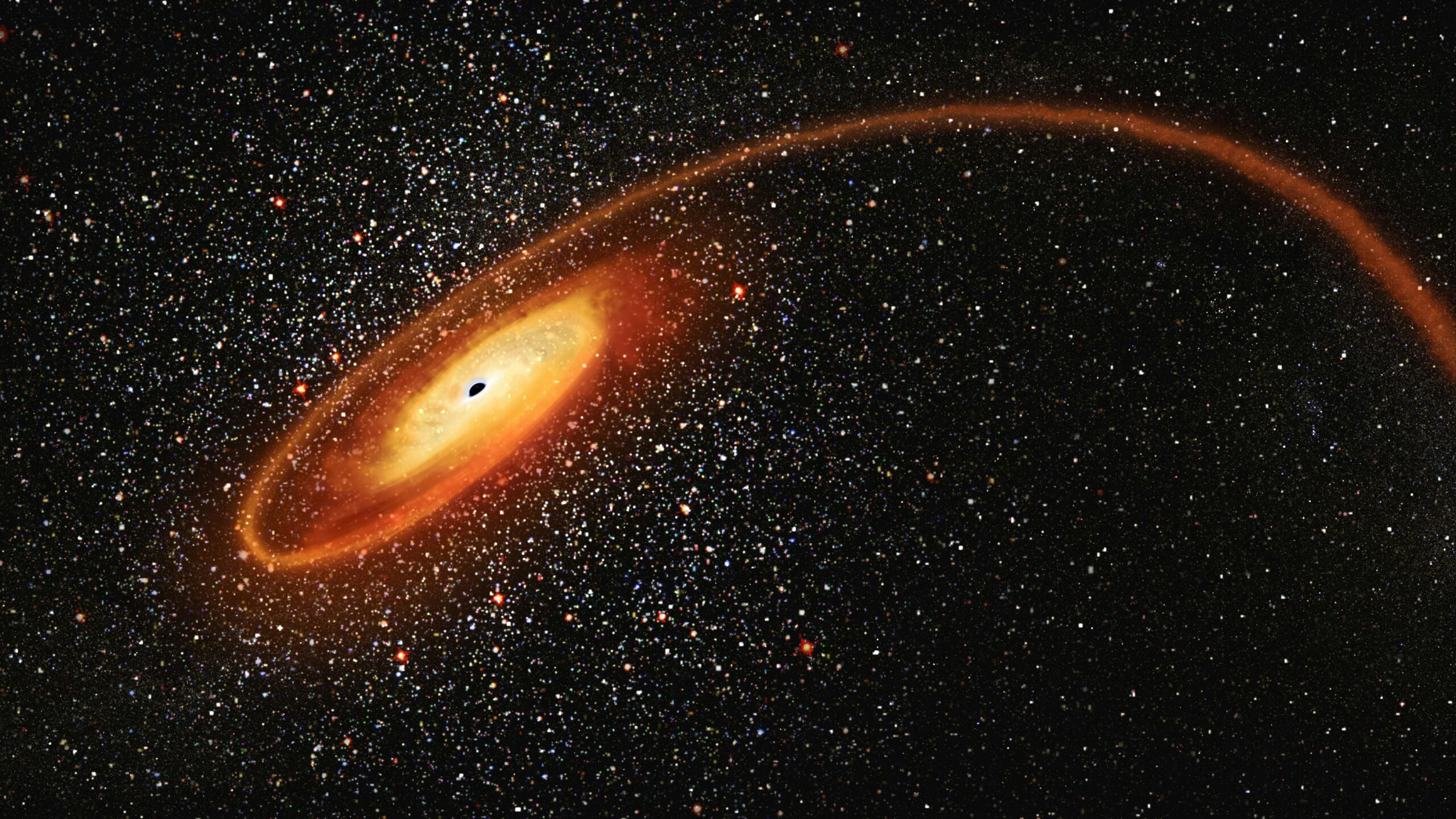
Meanwhile, back in the far reaches of the universe, scientists have detected the heaviest black hole merger ever observed – thanks to a network of observatories including LIGO, Virgo, and KAGRA.
Known (rather unromantically) as GW231123, the event involves two black holes:
- One with a mass of 103 times our Sun
- Another with 137 solar masses
- Merging to form a new black hole of 225 solar masses
An incredible 15 solar masses worth of energy was released in the form of gravitational waves and X-rays—rippling across the cosmos and detected here on Earth by specialised instruments.
“Gravitational waves cause space itself to stretch and compress. You won’t feel it, but our detectors absolutely can,” Matt explained.
This merger not only shatters previous records, but it also challenges existing models of black hole formation. Under current theories, stars of that size should explode entirely—not leave black holes behind. Scientists are now exploring whether this could be the result of multiple generations of black hole mergers, or perhaps something even more exotic.
What’s Next?
Thanks to groundbreaking technology like the soon-to-launch Rubin Observatory, which will capture 15 terabytes of sky images every night, we’re entering a golden age of space discovery.
“We estimate there are around 10,000 interstellar objects inside Neptune’s orbit at any given time,” Matt shared. “With the Rubin Observatory, we’ll be able to find and study more of them than ever before.”
Whether it’s ancient comets or mysterious black holes, the universe continues to surprise us, and we’re so glad to have Matt on board to help make sense of it all.
Stay tuned to Bec & Asa for their Science Segment for more stories from the stars!
🔭 Want to explore more? Visit perthobservatory.com.au or listen to this full chat with Matt below.